
Collecting human data at scale usually means going through a platform that connects you to a paid crowd. Prolific has become the industry standard for this kind of work, with a panel that is paid by the hour.
Rapidata sources people through ads distributed across a network of consumer apps, reaching thousands of people on their devices within seconds. You pay for the distribution; the annotators participate voluntarily and are not compensated monetarily, reducing incentives to game the system.
We wanted to quantify the trade-offs, so we asked both crowds the same 300 questions with known answers and measured the three things a labeling budget cares about: speed, cost, and annotation quality. In the spirit of transparency, all data from the experiment is publicly available on Hugging Face.
The two platforms
Prolific
Prolific runs a standing panel. Participants apply, pass identity verification, and build a track record as they work: researchers approve or reject each submission, and the approval rate follows the participant. Studies can screen the panel on a long list of demographic attributes.
Running a study means publishing it to that panel with a description, an estimated duration, and a link to the task. The task interface itself is the client's responsibility: Prolific brings the participants, but presenting the questions, recording the answers, and keeping it all accessible on the participants' devices is up to you. For this experiment that meant building and hosting a small web app with a scoring server behind it.
Pricing follows from time. You pay a fixed reward per participant, sized from your estimated completion time at an hourly rate; Prolific recommends a rate, £19.40 per hour at the time of our study. Quality rests on the vetting and the hourly relationship, with attention checks as an accepted practice.
Rapidata
Rapidata's tasks are placed as short sessions inside a network of consumer apps, where people can opt in to solve tasks instead of having to watch ads. The crowd this reaches is global and, at any given moment, very large.
Quality is handled by up-front vetting followed by continuous measurement. New annotators are onboarded with questions whose answers are known, gold-standard tasks stay mixed into the regular stream afterwards, and every person carries a running score that corrects for chance. Every answer arrives stamped with its author's current score, so downstream you can weight or filter by reliability.
The task interface comes with the platform: Rapidata renders each task inside the ads, so there is nothing for you to build or host. Setting up an experiment is a single API call that carries the datapoints, the instruction, and the number of responses you want per datapoint. Orders can target countries, languages, and demographics. On top of the continuous evaluation, we recommend collecting at least five responses per datapoint; the speed and cost numbers below show why that is easily affordable.
The difference in setup effort is worth a picture:
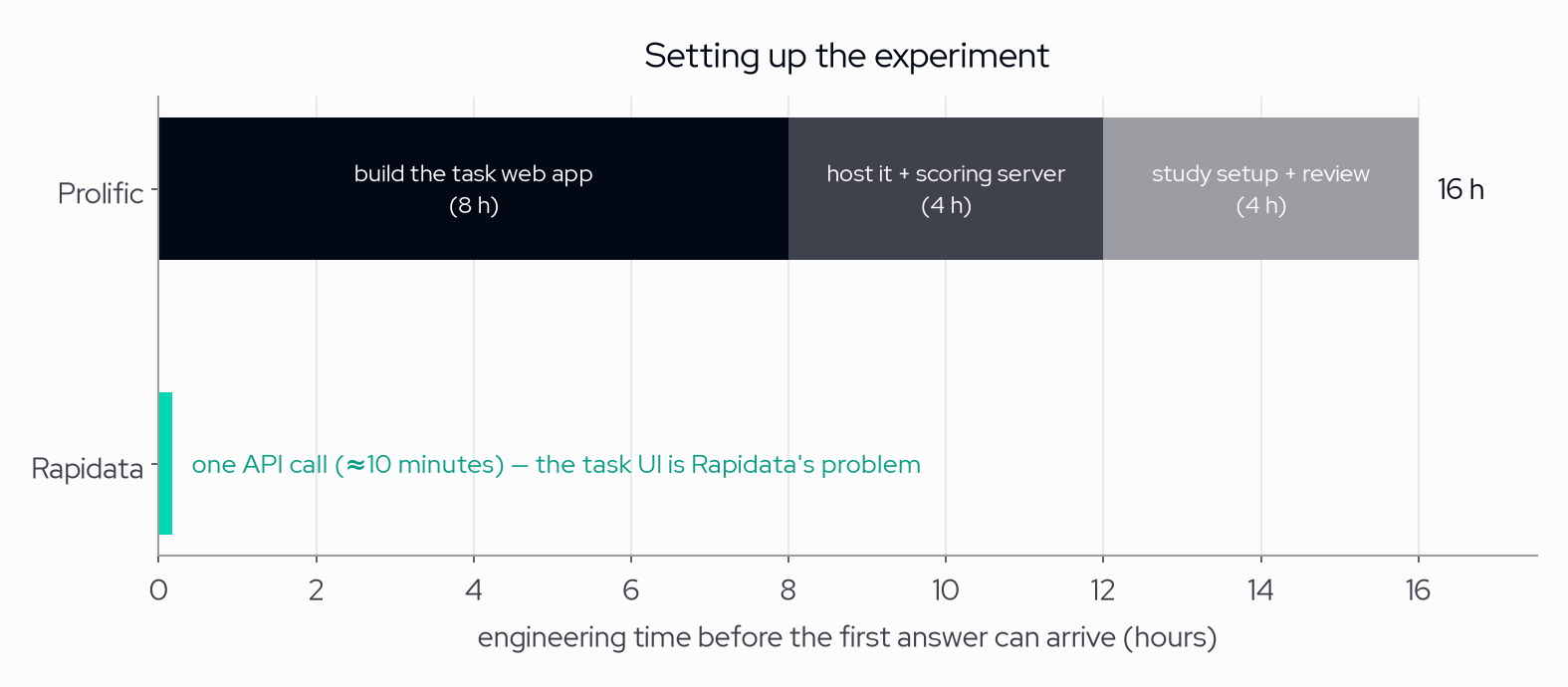
Estimated engineering time from our own setup: Prolific needs a task app at a public URL before anyone can answer, while Rapidata renders the task for you.
Experiment setup
The two platforms work differently by design, so the setups cannot be replicated one-to-one; we followed each platform's best practices and kept everything else the same: the questions, the ground truth, and the grading.
The dataset is 300 questions with a fixed format: a short line of text and two images, pick the image that matches.
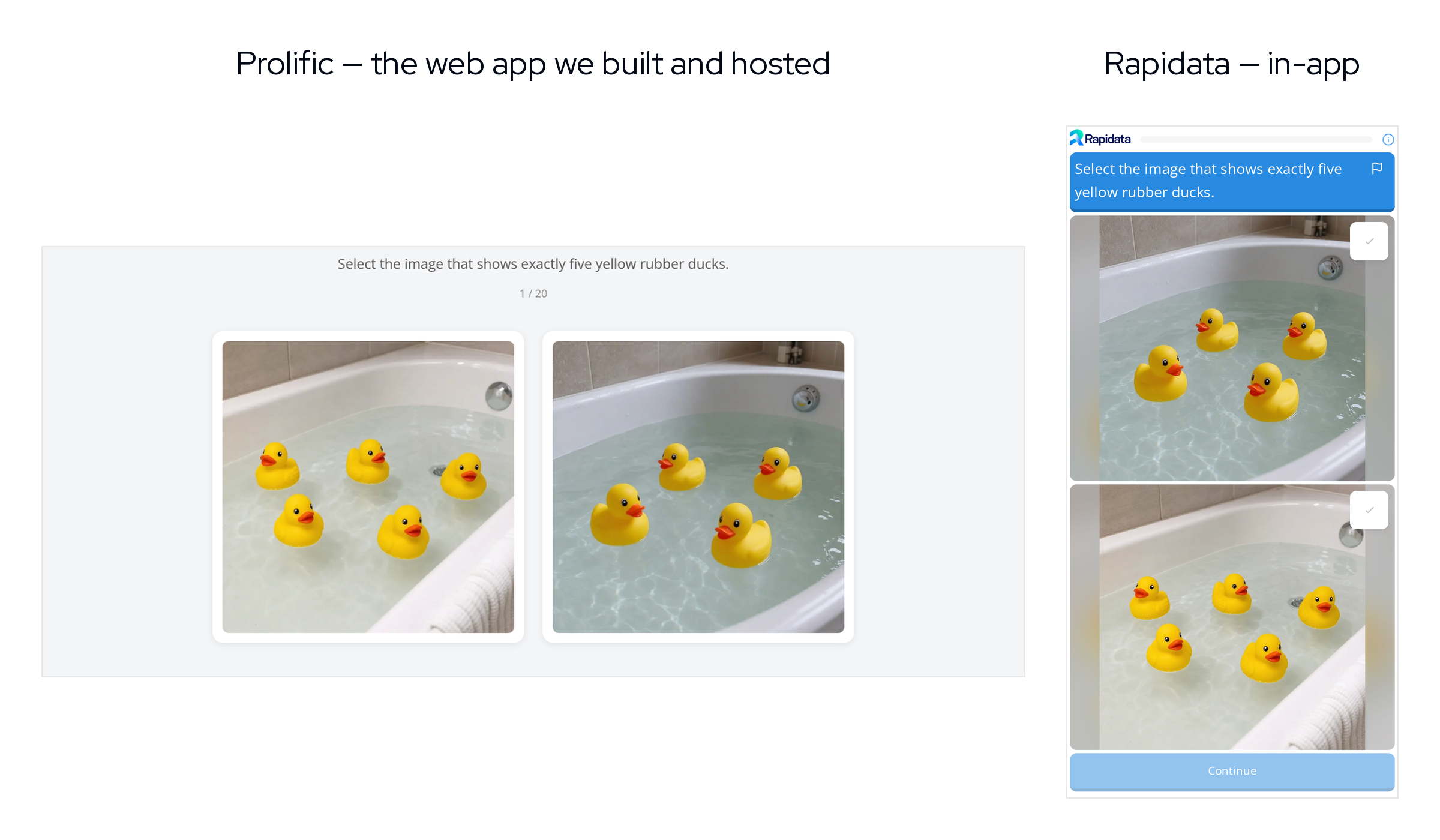
One of the 300 questions as each crowd saw it: the web app we built and hosted for Prolific participants (left) and Rapidata's in-app rendering (right).
The 300 questions cover simple object recognition and six attention skills: counting, absence, search, spatial relations, object state, and attribute binding. None of them require specialized knowledge. A question is only ever difficult because it takes a careful look, like the one above, where the wrong image shows a different number of ducks. Every question has a known correct answer, so every response could be graded.
On Prolific, 150 participants each completed one 20-question session in our web app. We collected ten answers per question, with the reward sized from the estimated completion time at the recommended £19.40 per hour.
On Rapidata, a single order collected 50 answers per question from the global crowd; the questions were served in short in-app sessions. Where we compare single answers below, we subsample Rapidata to ten answers per question, so both crowds are judged at equal depth.
Results
Speed
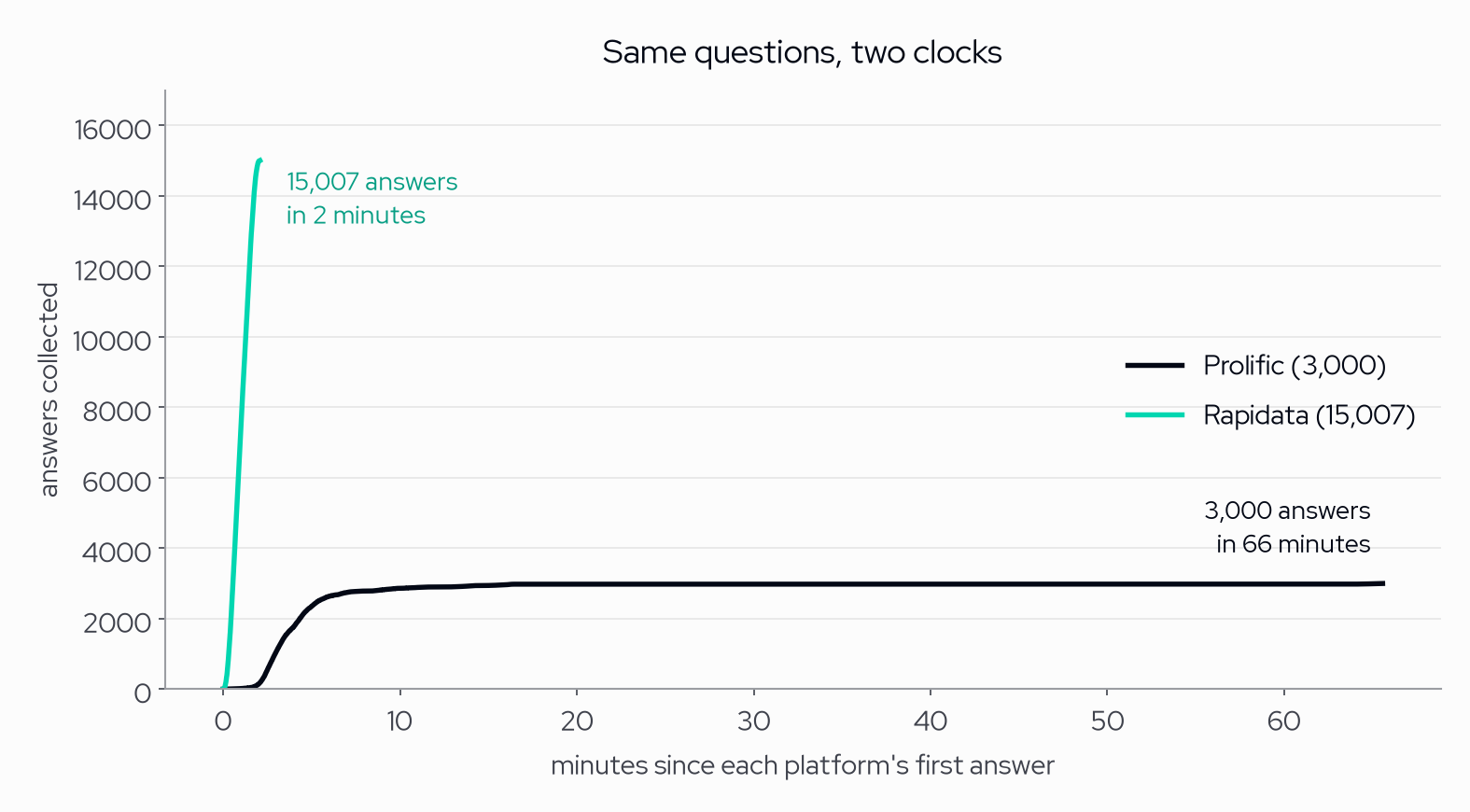
Answers collected over time, counted from each platform's first answer.
Prolific was quick for a hired panel: 78% of its 3,000 answers arrived within the first five minutes, 95% within ten, and the last after 66 minutes, not counting the time to publish the study. The median participant finished the 20 questions in under two minutes, faster than the estimate the reward was based on, so the fixed reward worked out to roughly £25.67 per hour in practice.
On Rapidata, all 15,000 answers arrived within about two minutes. They came from 5,103 people — the 3,000 matching Prolific's depth from 2,316 — with the median annotator contributing 3 answers.
Annotation quality
To ensure quality and consistency, it is standard practice to collect several responses per item and take the majority as the label, and both platforms recommend working this way; on Rapidata we recommend at least five responses per datapoint. Accuracy as a function of responses per question is therefore the central result of the experiment:
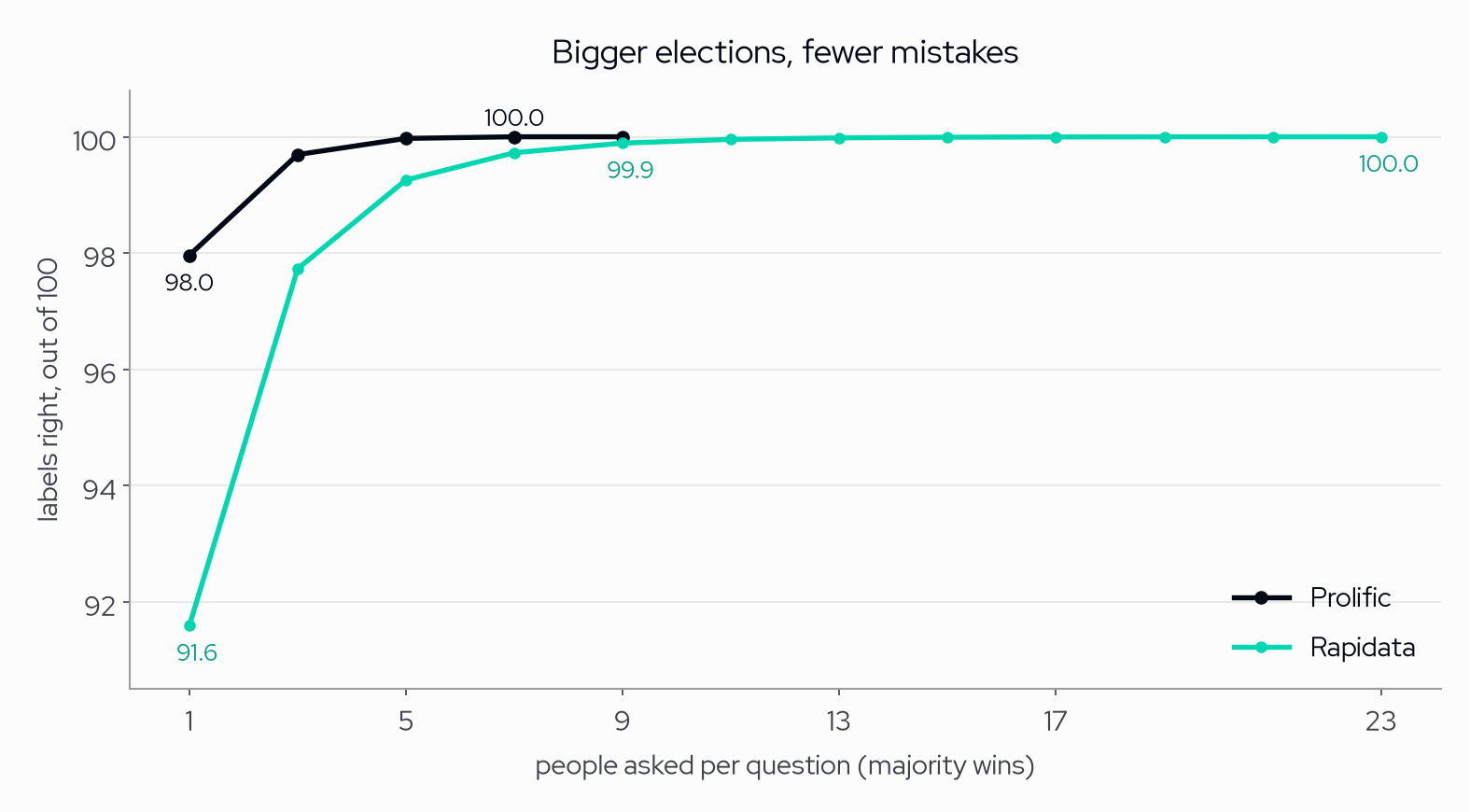
Accuracy of the majority label as responses per question are added.
Prolific's majority answers all 300 questions correctly from seven responses per question. Rapidata reaches 99.9% accuracy at nine responses and answers all 300 correctly from 23. Already at the recommended five responses, Rapidata's majority beats a single Prolific answer, and with all answers counted, neither crowd got a single question majority-wrong. Graded answer by answer, Prolific comes out ahead: its overall accuracy was 98.0%, against 91.6% for Rapidata's unfiltered crowd — the gap the extra responses close.
Cost
The cost came out to $76 per 1,000 answers on Prolific and $4 per 1,000 on Rapidata, a 19× difference per answer. As introduced, for a final label one typically employs consensus across n answers, where n is chosen to achieve the desired expected accuracy. The figure below gives a breakdown of how that looks for this experiment:
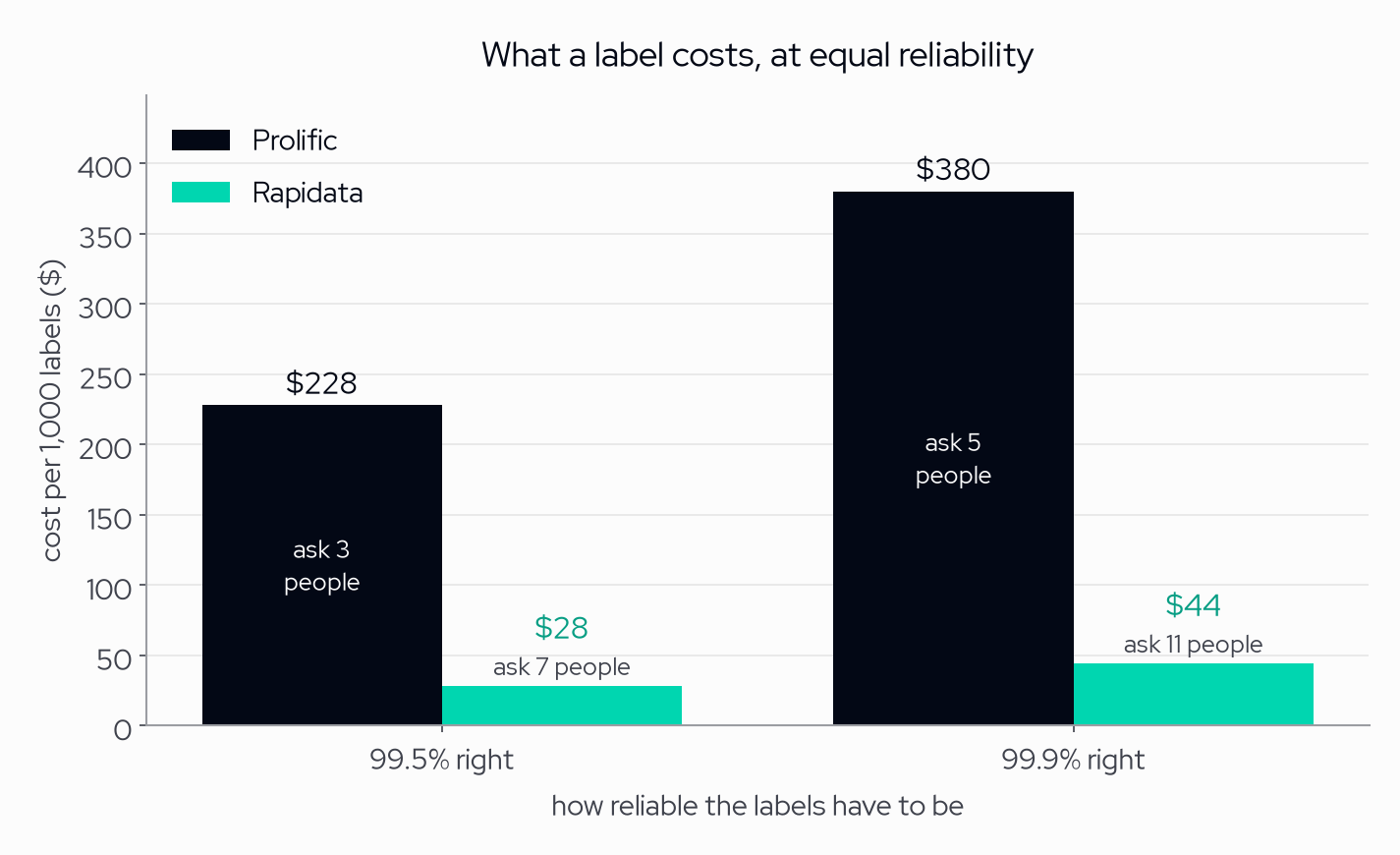
The price of 1,000 labels at each reliability level; the small text is how many people each platform needs to ask per label.
At the recommended five responses, a Rapidata label costs 2 cents and is more accurate than a single Prolific answer at 7.6 cents. The same arithmetic applies to time: at the measured collection speeds, Prolific produces roughly 15 labels per minute at 99.5% reliability, Rapidata roughly 1,000.
Recap
| Prolific | Rapidata | |
|---|---|---|
| Price of 1,000 answers | $76 | $4 |
| Price of 1,000 labels, ≥99.5% right | $228 | $28 |
| Task interface provided | ✗ — you build and host it | ✓ — rendered in-app |
| Collection speed | ~45 answers per minute | ~7,500 answers per minute |
| People behind those answers | 150 | 5,103 |
Both platforms buy quality the same way — ask more people per question and let the majority decide — so the whole comparison fits in one picture of what each level of quality costs:
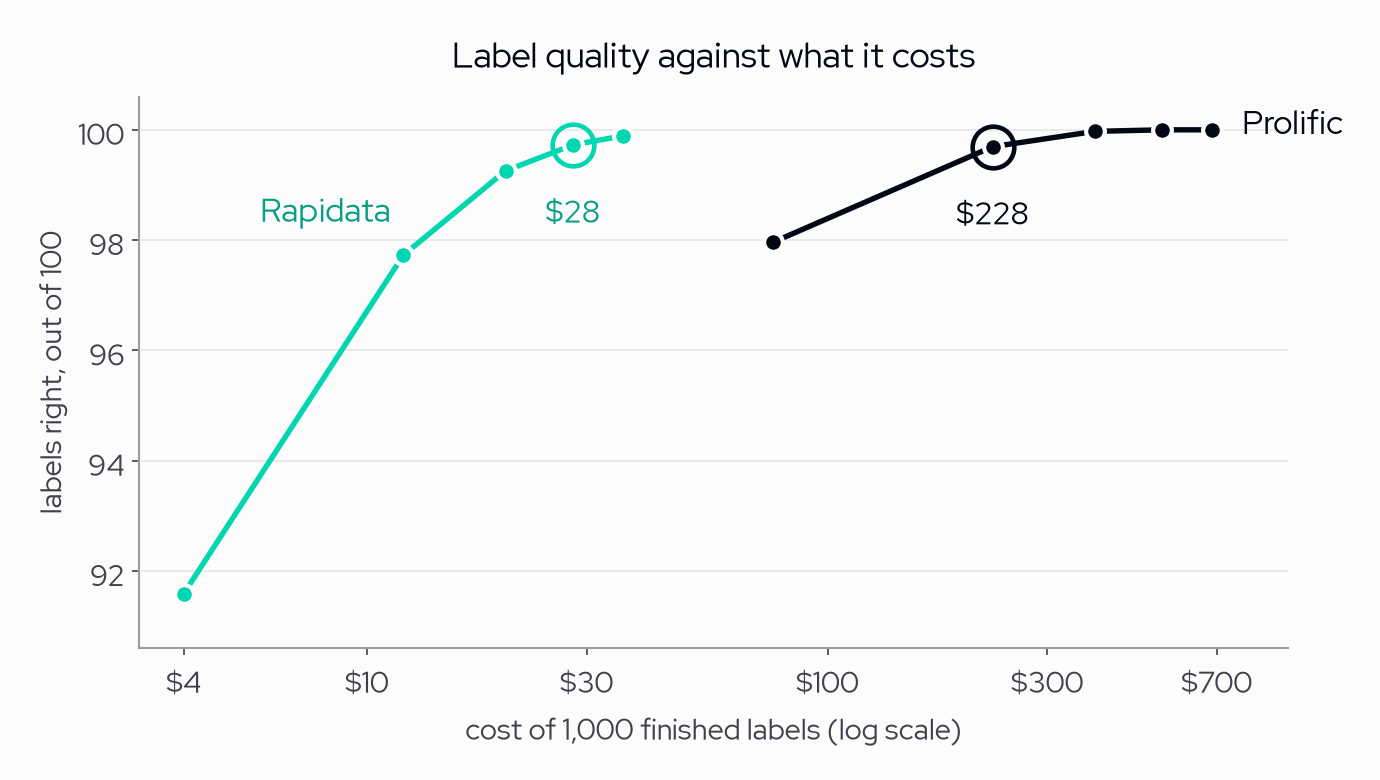
Each dot is one more person asked per question, with the majority answer taken as the label. The two ringed dots are where the crowds meet on quality: seven Rapidata answers at $4.00 per thousand make a label for $28.00 at 99.73% correct, against three Prolific answers at $76.11 for $228.34 at 99.69% — the same accuracy for 8.2 times the price.
While the individual vote accuracy is higher at Prolific, in a practical use case, factoring in time and cost, Rapidata can deliver the same final annotation quality 70 times faster and 8 times cheaper.